Skin cancer is the most common cancer in the United States — more cases diagnosed annually than all other cancers combined. The three main types (basal cell carcinoma, squamous cell carcinoma, and melanoma) have vastly different malignant potentials but share a common preventable cause: excessive ultraviolet radiation exposure. Dermatology clinics provide the systematic full-body skin examinations, biopsy capabilities, and treatment expertise that catch skin cancer early, when treatment is most straightforward and outcomes are best. This guide explains skin cancer screening at dermatology clinics.
The Full-Body Skin Exam
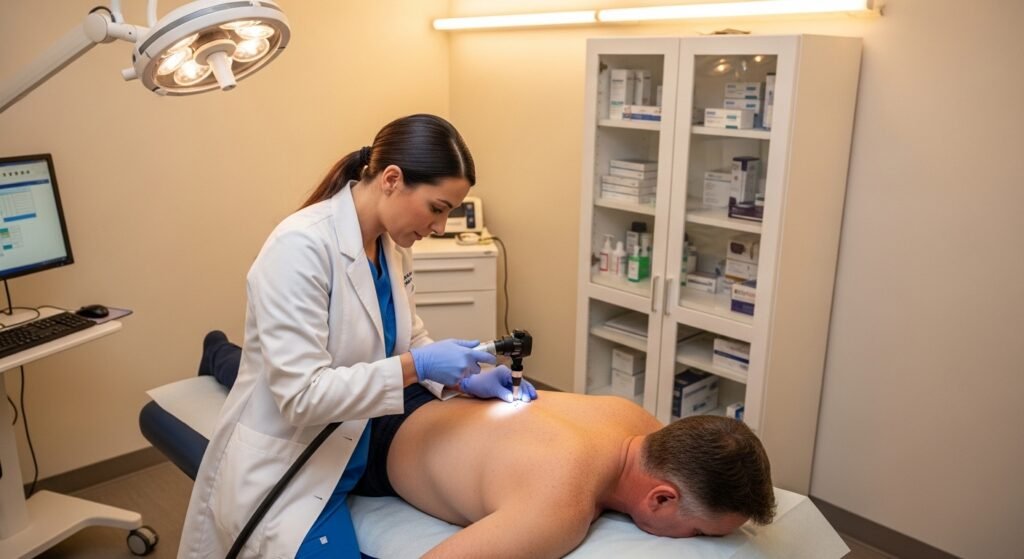
A full-body skin exam (FBSE) performed by a dermatologist involves systematic, head-to-toe examination of every inch of skin — including the scalp, behind the ears, between the toes, and under the nails — evaluating every mole, lesion, and area of abnormality. Dermoscopy (magnified, illuminated examination of skin lesions with a handheld device) significantly improves the accuracy of clinical diagnosis. Suspicious lesions are biopsied in the office under local anesthesia for definitive pathological diagnosis.
Melanoma: Recognizing the Most Dangerous Skin Cancer
Melanoma accounts for less than 2% of skin cancer cases but the majority of skin cancer deaths. The ABCDE criteria guide melanoma recognition: Asymmetry, Border irregularity, Color variation (multiple shades within one lesion), Diameter greater than 6mm (pencil eraser), Evolution (change over time). Any lesion with these features warrants prompt dermatological evaluation. Early melanoma (Stage I) has a 5-year survival rate above 97%; Stage IV melanoma, approximately 30%.
Who Should Be Screened
Annual dermatological skin exams are particularly important for: adults with significant lifetime UV exposure, history of previous skin cancer, fair skin, many moles, family history of melanoma, and immunosuppression. Personal monthly self-examination using a mirror system (including back and scalp views) complements clinical surveillance between annual exams.
Conclusion
Skin cancer is common, largely preventable, and highly treatable when detected early. Annual dermatological screening combined with sun protection habits (broad-spectrum SPF 30+ sunscreen, protective clothing, avoiding peak UV hours, avoiding tanning beds) provides comprehensive skin cancer prevention and detection. Do not neglect this aspect of your preventive healthcare.
FAQs – Skin Cancer Screening
Q1. How often should I see a dermatologist for skin cancer screening?
A: Once a year for adults with risk factors. The American Academy of Dermatology recommends regular professional skin checks but does not specify a universal interval — discuss your personal risk with your dermatologist.
Q2. Can dark-skinned people get skin cancer?
A: Yes. People of all skin tones can develop skin cancer. While UV-related skin cancer is less common in darker skin, it is often diagnosed at later stages in people of color — partly because skin cancer awareness campaigns have historically focused on lighter-skinned populations.
Q3. Does sunscreen truly prevent skin cancer?
A: Yes. Regular use of broad-spectrum sunscreen (SPF 30 or higher) reduces the risk of squamous cell carcinoma by 40% and melanoma by 50%, according to clinical trial data. Reapplication every 2 hours and after swimming or sweating is essential for effectiveness.
Q4. What happens after a suspicious lesion is biopsied?
A: The biopsy sample is examined by a dermatopathologist. Results typically return in 3–7 days. If benign, no further action is needed. If malignant or atypical, your dermatologist discusses treatment options and follow-up monitoring.
Q5. Can tanning beds cause skin cancer?
A: Yes. Indoor tanning increases melanoma risk by 75% when used before age 35. This risk has been so clearly established that tanning beds are now classified as carcinogenic to humans by the WHO. There is no “safe” level of indoor tanning.