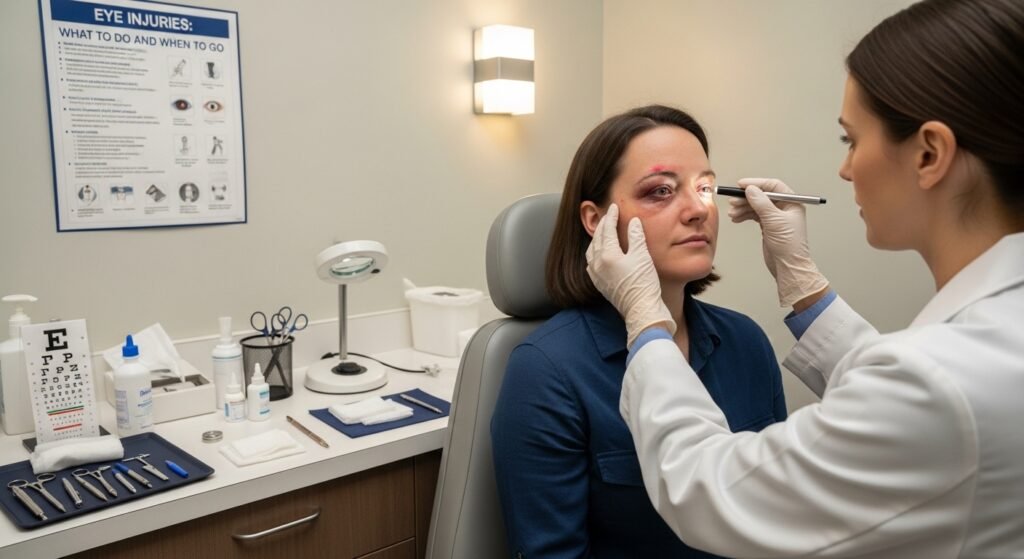
Eye injuries — from foreign bodies, chemical splashes, blunt trauma, lacerations, and thermal burns — require prompt, appropriate response to prevent vision loss. The eye is remarkably vulnerable yet recoverable with correct first aid and timely clinical evaluation. Medical and ophthalmology clinics evaluate and treat the majority of eye injuries; some require immediate emergency ophthalmology referral. This guide explains initial response and clinical management of eye injuries.
Chemical Eye Injuries: The Ultimate Emergency
Chemical exposure to the eye requires immediate, continuous copious irrigation with water — beginning before calling for help, before going to any clinic, and continuing for at least 15–20 minutes. Alkali burns (lye, cement dust, drain cleaners) penetrate deeply and cause severe damage; acid burns are less penetrating but still serious. Do not delay irrigation for any reason — each minute without irrigation worsens the prognosis. After irrigation, seek urgent ophthalmology evaluation.
Foreign Body in the Eye
Superficial foreign bodies (sand, dust, eyelash) often wash out with blinking and tearing or can be removed with gentle irrigation. Metallic foreign bodies embedded in the cornea require slit lamp examination and careful removal at an eye clinic — metal oxidizes and creates a “rust ring” that must also be removed. Never attempt to remove an embedded foreign body yourself — you risk additional damage. An object penetrating the eye (not just on the surface) is an ocular emergency requiring immediate emergency ophthalmology evaluation without pressure on the globe.
Blunt Eye Trauma
Blunt trauma can cause hyphema (blood in the anterior chamber), orbital fracture, lens dislocation, vitreous hemorrhage, and retinal detachment — all requiring ophthalmology evaluation. Any significant blunt eye injury with pain, vision change, or blood visible in the eye warrants urgent ophthalmological assessment.
Conclusion
For chemical eye injuries: irrigate immediately, continuously, and urgently — this is the most time-critical injury in ophthalmology. For other eye injuries: protect the eye (no pressure, protective cup over penetrating injuries), avoid rubbing, and seek prompt ophthalmology or emergency clinic evaluation for any injury with vision change, significant pain, visible bleeding, or an object that cannot be easily rinsed away.
FAQs – Eye Injuries
Q1. How do I remove something from my eye?
A: For loose particles (sand, dust): blink repeatedly; flush with clean water or saline; gently pull the upper lid over the lower lid. For objects you can see and reach with the corner of a clean cloth: carefully attempt single gentle removal. For embedded objects, objects on the cornea, or anything you cannot easily remove: do not attempt further removal and seek clinic evaluation.
Q2. What is a hyphema?
A: A hyphema is a collection of blood in the anterior chamber of the eye (between the cornea and iris), typically following blunt eye trauma. It appears as a reddish layer at the bottom of the iris. All hyphemas require ophthalmology evaluation — they can cause elevated intraocular pressure and risk of permanent vision impairment.
Q3. Can I wear contact lenses after an eye injury?
A: No. Remove contact lenses promptly following any eye injury (except penetrating injuries where removal might cause additional damage) and do not replace them until cleared by your eye doctor. Contact lenses on an injured eye increase infection risk and impair wound healing.
Q4. What are the signs of a retinal detachment?
A: Sudden increase in floaters (dark spots or threads in vision), flashes of light (photopsia), and a curtain or shadow advancing across the visual field are classic signs of retinal detachment — an ophthalmological emergency requiring immediate evaluation. Retinal detachment can be repaired if treated promptly; delay risks permanent vision loss.
Q5. Is it dangerous to look at the sun or welding arc?
A: Yes. Solar retinopathy (from staring at the sun or a solar eclipse without protection) and photokeratitis (welder’s flash — UV burn of the cornea from welding arc without appropriate eye protection) cause significant, sometimes permanent vision damage. Welder’s flash typically causes intense eye pain and photophobia 6–12 hours after exposure and requires ophthalmology evaluation.