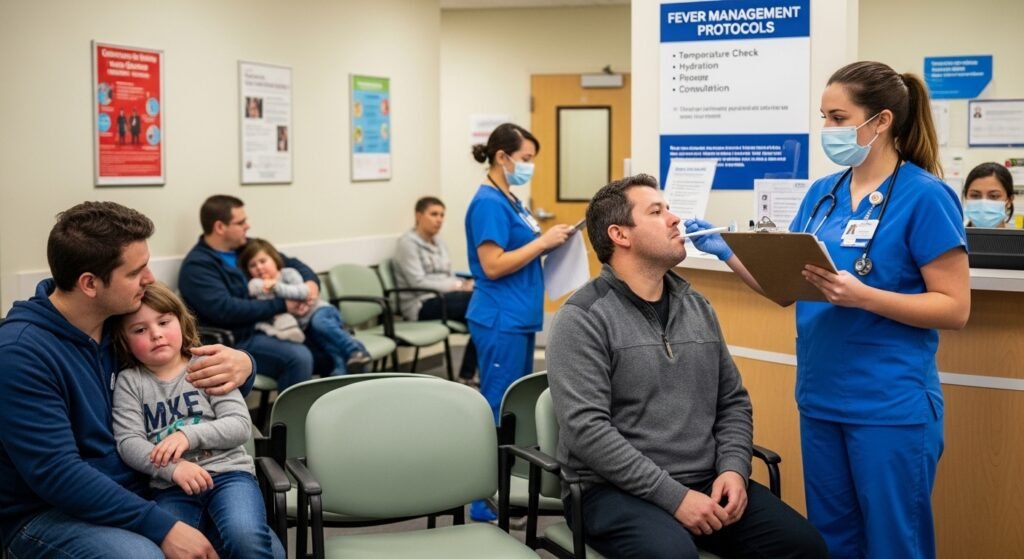
Fever — defined as oral temperature above 38°C (100.4°F) — is one of the most common reasons patients seek care at medical clinics. While fever is alarming to patients and parents, it is primarily a symptom indicating that the immune system is responding to something — most commonly, a self-limited viral infection that resolves without specific treatment. Understanding when fever requires clinic evaluation, how clinics assess its cause, and when fever itself requires specific management helps patients make appropriate healthcare decisions. This guide explains clinical fever assessment and management.
When to Seek Clinic Care for Fever
All fever in infants under 3 months (rectal temperature 38°C or above) requires immediate clinic or emergency evaluation — this is a medical emergency. Children aged 3–36 months with fever above 39°C (102.2°F), any patient with fever persisting more than 3–5 days, fever with rash, stiff neck, severe headache, difficulty breathing, or altered mental status requires urgent evaluation. Adults with fever over 39.4°C (103°F), immunocompromised patients (including chemotherapy patients, organ transplant recipients, HIV patients on treatment), and any patient who appears seriously ill warrant prompt clinical evaluation.
Clinic Evaluation of Fever
The clinical evaluation focuses on identifying the source of infection: detailed history (duration, associated symptoms, sick contacts, recent travel, immunization status), comprehensive physical examination (ears, throat, lymph nodes, lungs, abdomen, skin for rash), and targeted testing as indicated (throat culture, urinalysis, blood tests, chest X-ray). The history and physical examination guide appropriate investigation rather than ordering every possible test for every fever.
Antipyretic Treatment
Fever treatment reduces discomfort and prevents fever-associated complications (febrile seizures in susceptible children) but does not treat the underlying cause. Acetaminophen and ibuprofen are equally effective antipyretics with different dosing intervals (acetaminophen every 4–6 hours; ibuprofen every 6–8 hours — not recommended under 6 months). Alternating the two provides more sustained fever control for very high or recurrent fevers. Aspirin is not used for fever in children due to Reye’s syndrome risk.
Conclusion
Most fevers in otherwise healthy patients are caused by self-limited viral infections that resolve without specific treatment. The clinical goal is identifying the rare fever that indicates a bacterial infection requiring antibiotics or another serious underlying cause requiring specific intervention. Clinic evaluation is appropriate when fever is high, prolonged, associated with alarming symptoms, or occurs in high-risk patients — in otherwise healthy adults and children with mild febrile illness and minimal accompanying symptoms, watchful observation is often sufficient.
FAQs – Fever Management
Q1. Does a higher fever always mean a more serious illness?
A: Not necessarily. Fever height alone is a poor indicator of illness severity, particularly in children. A child with a temperature of 40°C (104°F) who is alert, interactive, and consolable is often less concerning than a mildly febrile child who appears ill, toxic, or inconsolable.
Q2. Should I always go to the clinic for a fever?
A: Not always. In otherwise healthy adults with low-grade fever and mild accompanying symptoms (mild cold, mild flu-like illness), watchful management at home with antipyretics and hydration is often appropriate. Clinic evaluation is warranted for the indications listed above: high fever, prolonged fever, alarming associated symptoms, or high-risk patient groups.
Q3. Can children get febrile seizures?
A: Yes. Febrile seizures occur in 2–5% of children ages 6 months to 5 years, typically with rapid rise in temperature. Simple febrile seizures (brief, generalized, resolving quickly without recurrence in the same illness) are generally benign and do not increase long-term epilepsy risk. Complex febrile seizures require more thorough evaluation. Call 911 for any child having a first seizure.
Q4. Does sweating mean a fever is breaking?
A: Sweating indicates the hypothalamic temperature setpoint is returning to normal and the fever is decreasing — often called “breaking” the fever. This is a normal and positive sign of fever resolution, not a cause for concern.
Q5. How should I take an accurate temperature?
A: For infants under 3 years: rectal temperature is most accurate. For children and adults: oral temperature is standard. Tympanic (ear) and temporal artery thermometers are convenient but less accurate — they are useful for screening but not definitive medical temperature assessment. Digital thermometers are preferred over mercury thermometers (which have been discontinued for environmental safety reasons).