Discover how advanced diagnostics improve medical treatment accuracy, enable early disease detection, and enhance patient outcomes through cutting-edge technologies and precision healthcare.
Modern healthcare has undergone a dramatic transformation over the past few decades, largely due to the rise of advanced diagnostic technologies. From identifying diseases at their earliest stages to guiding highly personalized treatment plans, diagnostics now play a central role in improving patient outcomes. In today’s fast-paced medical environment, accurate and timely diagnosis is no longer optional—it is essential.
Advanced diagnostics bridge the gap between symptoms and effective treatment. They empower healthcare professionals to make informed decisions, reduce uncertainties, and deliver targeted therapies. This article explores how advanced diagnostics contribute to effective medical treatment, the technologies involved, and their impact on patient care.
What Are Advanced Diagnostics?
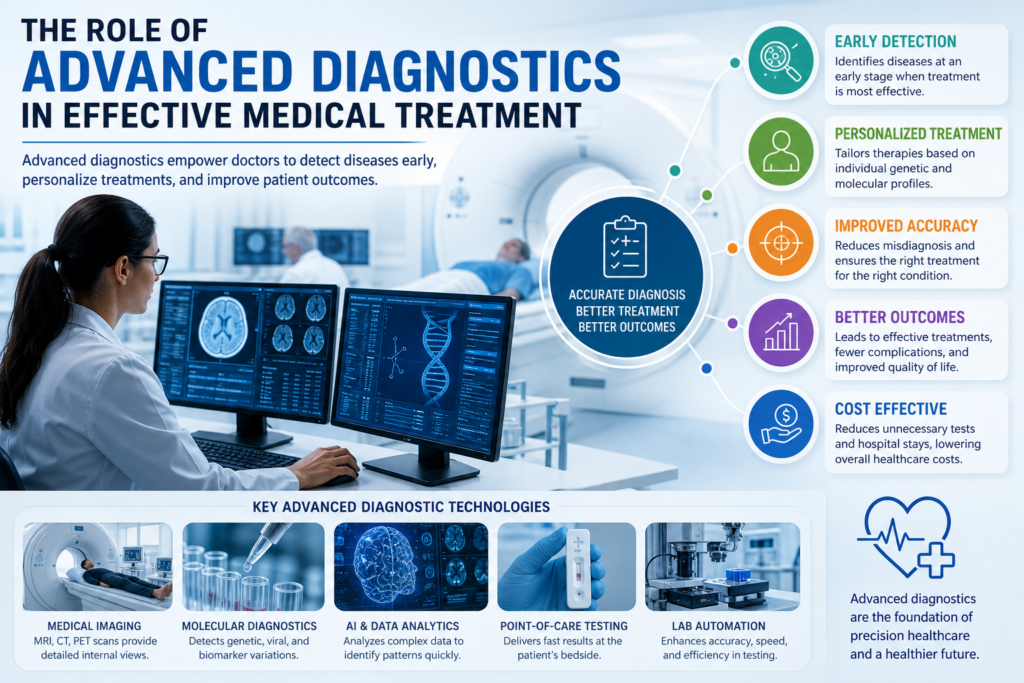
Advanced diagnostics refer to modern medical tools and techniques used to detect, monitor, and evaluate diseases with high precision. These include:
- Imaging technologies such as MRI, CT scans, and PET scans
- Molecular and genetic testing
- Laboratory automation and AI-powered diagnostics
- Point-of-care testing devices
Unlike traditional methods, advanced diagnostics offer faster, more accurate, and often non-invasive ways to assess a patient’s health condition.
Importance of Accurate Diagnosis in Treatment
A correct diagnosis is the foundation of effective treatment. Without it, even the best therapies may fail. Advanced diagnostics help in:
- Early Detection: Identifying diseases before symptoms become severe
- Precision Medicine: Tailoring treatments based on individual patient data
- Reduced Errors: Minimizing misdiagnosis and unnecessary treatments
- Better Monitoring: Tracking disease progression and treatment response
For example, detecting cancer at an early stage significantly increases survival rates, and advanced imaging plays a crucial role in this process.
Key Technologies in Advanced Diagnostics
1. Medical Imaging
Technologies like MRI (Magnetic Resonance Imaging), CT (Computed Tomography), and ultrasound provide detailed images of the body’s internal structures. These tools help doctors visualize abnormalities such as tumors, fractures, or organ damage.
2. Molecular Diagnostics
This involves analyzing biological markers in the genome and proteome. It is widely used for detecting infectious diseases, genetic disorders, and cancers. Techniques like PCR (Polymerase Chain Reaction) have revolutionized disease detection.
3. Artificial Intelligence in Diagnostics
AI-powered tools can analyze large volumes of medical data quickly and accurately. They assist in identifying patterns that may be missed by human observation, improving diagnostic accuracy and speed.
4. Point-of-Care Testing (POCT)
These are portable diagnostic devices used at the patient’s bedside. They provide immediate results, enabling quick decision-making, especially in emergency situations.
Role in Early Disease Detection
One of the most significant advantages of advanced diagnostics is early detection. Diseases like cancer, diabetes, and heart conditions often develop silently. Advanced tools can identify subtle changes in the body before symptoms appear.
Early detection leads to:
- Less aggressive treatment
- Lower healthcare costs
- Higher survival rates
- Improved quality of life
Screening programs using advanced diagnostics have proven effective in reducing mortality rates worldwide.
Enhancing Personalized Medicine
Personalized or precision medicine is an approach where treatment is customized based on an individual’s genetic makeup, lifestyle, and environment. Advanced diagnostics play a key role by providing detailed insights into a patient’s condition.
For instance, genetic testing can determine how a patient will respond to a specific drug, allowing doctors to choose the most effective therapy with minimal side effects.
Improving Treatment Outcomes
Advanced diagnostics not only help in identifying diseases but also in monitoring treatment effectiveness. Regular diagnostic tests can:
- Track how well a treatment is working
- Detect complications early
- Adjust therapies as needed
This continuous feedback loop ensures that patients receive the most effective care throughout their treatment journey.
Reducing Healthcare Costs
While advanced diagnostic technologies may seem expensive initially, they often reduce overall healthcare costs by:
- Preventing disease progression
- Avoiding unnecessary treatments
- Reducing hospital stays
- Minimizing trial-and-error approaches
Efficient diagnostics lead to faster recovery and fewer complications, ultimately saving both time and money.
Challenges and Limitations
Despite their benefits, advanced diagnostics come with certain challenges:
- High Costs: Some technologies are expensive and not accessible to all
- Need for Skilled Professionals: Proper interpretation requires expertise
- Data Privacy Concerns: Handling sensitive patient data must be secure
- Overdiagnosis: Detecting conditions that may not require treatment
Addressing these challenges is essential to maximize the benefits of advanced diagnostics.
Future of Advanced Diagnostics
The future of diagnostics is promising, with innovations such as:
- AI-driven predictive diagnostics
- Wearable health monitoring devices
- Liquid biopsies for cancer detection
- Integration of big data in healthcare
These advancements will further enhance accuracy, accessibility, and efficiency in medical treatment.
Conclusion
Advanced diagnostics have revolutionized the way diseases are detected, treated, and managed. By enabling early detection, supporting personalized medicine, and improving treatment outcomes, they have become a cornerstone of modern healthcare.
As technology continues to evolve, the role of diagnostics will only become more significant. Investing in advanced diagnostic tools and making them accessible to a wider population is essential for building a healthier future.
FAQs
1. What are advanced diagnostics in healthcare?
Advanced diagnostics are modern medical techniques and technologies used to detect and monitor diseases with high accuracy.
2. How do advanced diagnostics improve treatment?
They provide precise information about a disease, enabling doctors to choose the most effective treatment plan.
3. Are advanced diagnostic tests expensive?
Some tests can be costly, but they often reduce overall healthcare expenses by preventing complications and unnecessary treatments.
4. What is the role of AI in diagnostics?
AI helps analyze medical data quickly and accurately, improving diagnosis and reducing human error.
5. Can advanced diagnostics detect diseases early?
Yes, they can identify diseases at an early stage, even before symptoms appear.