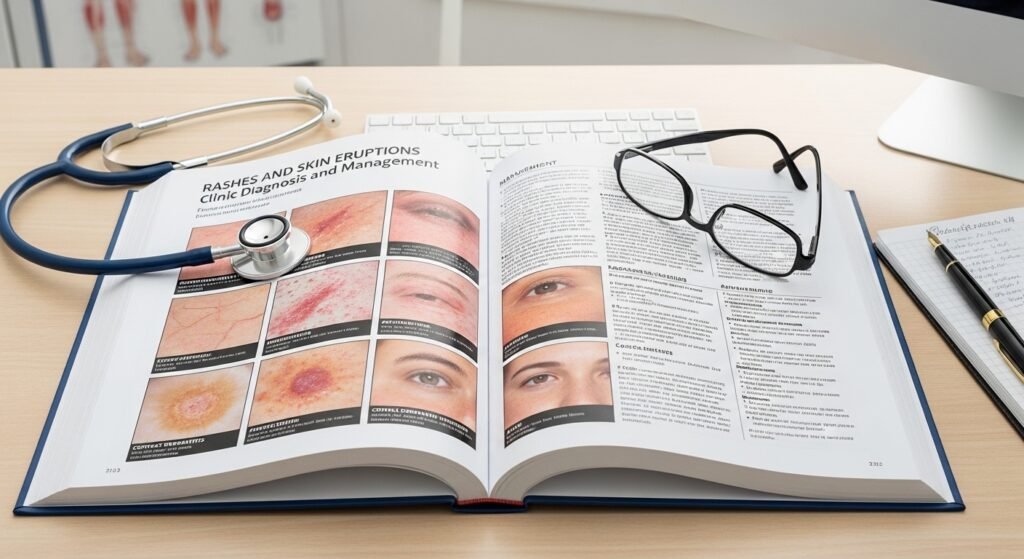
Skin rashes are one of the most common reasons for clinic visits across all specialties — estimated to account for 8–10% of all primary care visits. The differential diagnosis of rash is enormous — hundreds of conditions manifest in the skin — and visual characterization guides diagnostic reasoning. Understanding the basic categories of skin eruption and the red flag features that distinguish concerning from benign rashes helps patients seek care appropriately and communicate effectively with their providers. This guide explains clinical rash evaluation.
Clinical Characterization of Rashes
Clinicians characterize rashes by: distribution (localized vs. generalized, sun-exposed vs. unexposed areas, dermatome-following pattern); morphology (macules — flat color changes; papules — raised bumps; vesicles — fluid-filled blisters; pustules — pus-filled; wheals — hives; plaques — flat elevated areas; scaling or crusting); associated symptoms (itching, pain, fever, joint pain); and evolution (acute onset versus chronic, waxing and waning versus progressive). This systematic characterization narrows the differential dramatically.
Common Rash Categories
Allergic and Inflammatory Rashes
Contact dermatitis (localized reaction to touching an allergen — poison ivy, nickel, latex), urticaria (hives — generalized wheals from allergic or other triggers), and eczema (chronic inflammatory skin condition). Managed with avoidance, topical corticosteroids, and antihistamines.
Infectious Rashes
Tinea (fungal infections — ringworm, athlete’s foot, jock itch), impetigo (superficial bacterial infection in children), herpes simplex (vesicular eruptions), shingles (dermatomal vesicular rash from VZV reactivation), and viral exanthems (widespread rashes from systemic viral infections).
Red Flag Rashes Requiring Urgent Evaluation
Petechiae or purpura (pinpoint or larger non-blanching red-purple spots) may indicate meningococcemia or vasculitis — urgent emergency evaluation. Rapidly spreading red streaking from an infected wound (cellulitis with lymphangitis). Stevens-Johnson syndrome / toxic epidermal necrolysis — widespread skin blistering and mucous membrane involvement from drug reactions. Erythroderma — generalized skin redness affecting 90%+ body surface area.
Conclusion
Most rashes are benign and manageable through primary care and dermatology clinics. The key clinical skill is recognizing the minority of rashes that indicate serious systemic disease or require urgent treatment. Seek clinic evaluation for any rapidly spreading rash, non-blanching rash, rash with fever and systemic illness, rash associated with mucous membrane involvement, or rash following new medication introduction.
FAQs – Rashes
Q1. How can I tell if a rash is an allergic reaction?
A: Allergic rashes often appear as hives (wheals) — raised, itchy, migratory bumps that move around the body over hours. Contact allergic dermatitis follows the distribution of the contacted substance. Timing relative to a new medication, food, or substance exposure supports allergic causation. The non-blanching characteristic of petechiae and purpura (pressing a glass against them does not cause them to fade) distinguishes these serious rashes from benign inflammatory rashes.
Q2. What is shingles and who gets it?
A: Shingles (herpes zoster) is reactivation of the varicella-zoster virus (chickenpox) that remains dormant in nerve ganglia after initial infection. It typically presents with a painful, burning dermatomal rash — following the distribution of one nerve root, usually on one side of the torso or face — preceding and accompanying the distinctive vesicular eruption. Risk increases with age and immunosuppression. Shingles vaccination (Shingrix) is highly effective at preventing shingles and is recommended for adults 50 and older.
Q3. Can stress cause a rash?
A: Yes. Stress triggers or worsens multiple inflammatory skin conditions — eczema, psoriasis, seborrheic dermatitis, and hives all frequently flare with psychological stress. The stress-immune system-skin axis is well-established. Managing stress through behavioral interventions complements dermatological treatment for stress-sensitive skin conditions.
Q4. What is a drug rash and when does it appear?
A: Drug rashes most commonly appear 7–14 days after starting a new medication. Maculopapular (measles-like) drug rashes are most common — typically symmetric, widespread, and often clearing several days after the offending drug is discontinued. Stevens-Johnson syndrome (SJS) is a rare but severe drug reaction — characterized by blistering of skin and mucous membranes — that requires emergency evaluation and immediate drug discontinuation.
Q5. Can children transmit rashes to other children at school?
A: Some rash-associated conditions are contagious: impetigo, chickenpox (until all lesions are crusted), ringworm, hand-foot-and-mouth disease, and fifth disease in their contagious phases. Others are not contagious: eczema, contact dermatitis, allergic rashes. When in doubt, consult your clinic about whether school exclusion is appropriate for your child’s specific rash.