Magnetic resonance imaging (MRI) provides the most detailed soft tissue images available in clinical medicine — revealing brain structures, spinal cord, joint cartilage and ligaments, abdominal organs, heart function, and much more with extraordinary clarity. It uses powerful magnetic fields and radio waves rather than ionizing radiation, making it safe for most patients without the radiation concerns associated with X-ray and CT scanning. Many medical clinics coordinate MRI scheduling and interpretation. This guide explains what MRI scans are used for and what to expect.
How MRI Works
MRI scanners surround the patient with a powerful magnetic field that aligns protons in body tissues. Radiofrequency pulses then briefly disturb this alignment. As protons return to their aligned state, they emit signals that computers process into highly detailed anatomical images. Different tissue types — fat, fluid, muscle, bone marrow, tumor — return different signals, providing exceptional contrast between normal and abnormal tissue.
Common Clinical Applications
- Brain and spinal cord imaging (tumors, MS plaques, stroke, nerve compression)
- Joint imaging (meniscus and ligament tears, rotator cuff, labral tears)
- Cardiac MRI (heart structure, function, fibrosis)
- Abdominal imaging (liver lesions, pancreas, kidneys)
- Prostate MRI (cancer detection and characterization)
- Breast MRI (high-risk screening, surgical planning)
- Vascular imaging (MR angiography)
What to Expect During the Scan
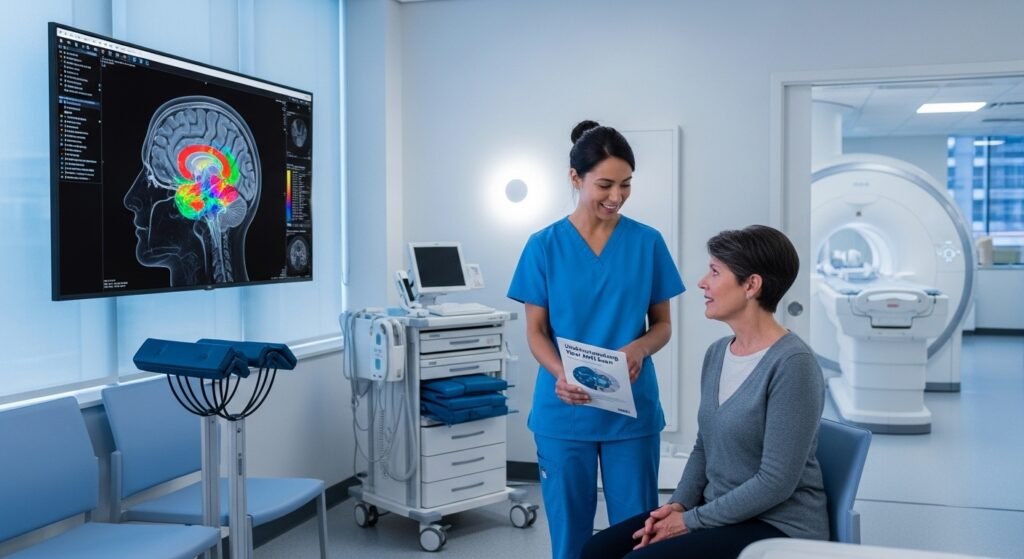
You will be asked to remove all metal objects (jewelry, hearing aids, removable dental work, piercings) and change into a hospital gown. You lie on a narrow table that slides into the MRI tube. The machine makes loud thumping and knocking noises during scanning — earplugs or headphones are provided. Scans typically take 30–60 minutes depending on body part and number of sequences. Contrast dye (gadolinium) injected intravenously enhances certain tissue types when needed. Claustrophobic patients may benefit from mild sedation or an open MRI option.
Conclusion
MRI provides unparalleled soft tissue imaging that guides diagnosis and treatment for a wide range of conditions. If your clinic orders an MRI, inform the radiology center about any implanted metal devices, prior MRI contrast reactions, and kidney function (which affects gadolinium use). Follow metal screening instructions carefully — safety in the MRI environment depends on thorough pre-scan screening.
FAQs – MRI Scans
Q1. Is MRI safe?
A: MRI is very safe for most people — it uses no ionizing radiation. The primary safety concern is the powerful magnet attracting ferromagnetic metal objects. People with certain implants (older cardiac pacemakers, cochlear implants, metal clips from certain surgeries) may not be MRI-eligible — screening is essential.
Q2. How long does an MRI take?
A: Typically 30–60 minutes depending on what area is being imaged and how many sequences are required. Cardiac and advanced neurological MRIs may take 60–90 minutes.
Q3. Can I have an MRI if I am claustrophobic?
A: Yes. Options include oral sedation before the scan, music or entertainment during the scan, and open MRI scanners (lower magnetic field strength but wider opening). Discuss claustrophobia concerns when scheduling.
Q4. What is MRI contrast dye and is it safe?
A: Gadolinium-based contrast agents (injected intravenously) enhance certain structures on MRI. They are generally very safe. In patients with severely impaired kidney function, gadolinium carries a rare risk of nephrogenic systemic fibrosis — kidney function is checked before contrast administration.
Q5. Do I need to fast before an MRI?
A: For most MRI scans, fasting is not required. Abdominal and pelvic MRIs may require fasting for 4–6 hours to reduce bowel gas interference. Follow your specific pre-scan instructions.