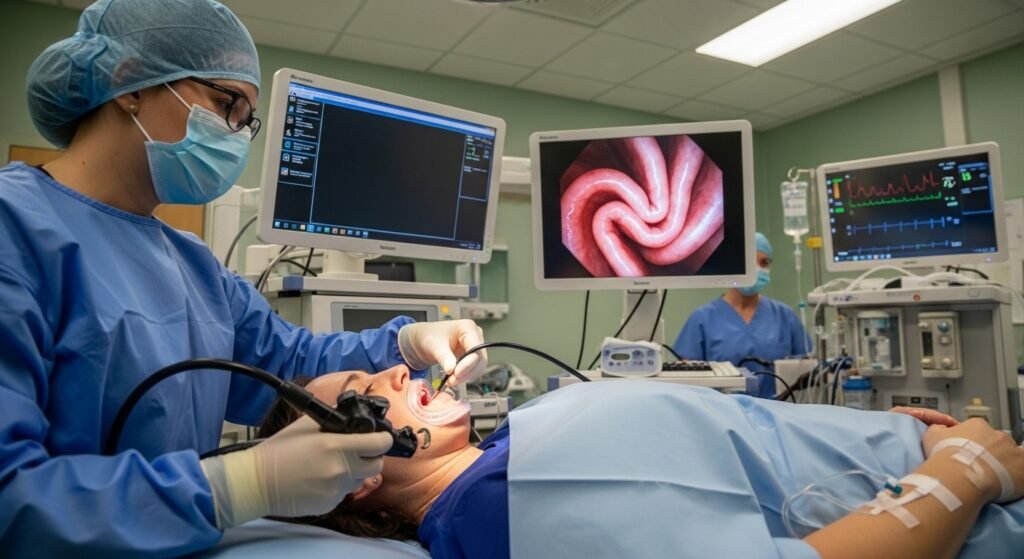
Upper endoscopy (esophagogastroduodenoscopy, or EGD) allows direct visual examination of the esophagus, stomach, and the first part of the small intestine (duodenum) using a flexible camera scope. It is one of the most commonly performed procedures at gastroenterology clinics, providing both diagnostic and therapeutic capabilities for a wide range of upper GI conditions. This guide explains what upper endoscopy involves and what patients can expect.
Indications for Upper Endoscopy
- Persistent heartburn or GERD not responding to treatment
- Difficulty swallowing (dysphagia)
- Unexplained upper abdominal pain
- Evaluation of Barrett’s esophagus
- Suspected peptic ulcer or H. pylori
- Upper GI bleeding evaluation and treatment
- Unexplained weight loss with upper GI symptoms
- Surveillance for esophageal or gastric cancer in high-risk patients
Preparation
You fast for at least 6–8 hours before an upper endoscopy — solid food for 8 hours, clear liquids for 4 hours. A responsible adult must drive you home. On arrival, a nurse places an IV, obtains your history, and administers sedation (typically propofol or midazolam). A throat spray may be applied for comfort.
The Procedure
With you lying on your left side and a bite guard in your mouth, the endoscopist passes the flexible scope through your mouth, down the esophagus, into the stomach, and through the pylorus into the duodenum. Air is infused to open the lumen for visualization. Biopsies, polyp removal, dilation of strictures, and treatment of bleeding are performed through instruments passed through the scope channel. The procedure typically takes 15–30 minutes.
Conclusion
Upper endoscopy is a fast, safe procedure performed under sedation that provides diagnostic clarity for upper GI symptoms that imaging cannot provide. Most patients tolerate it very well and are back to normal activities the following day. If your gastroenterologist recommends an EGD, the diagnostic information it provides is worth the brief inconvenience of the procedure.
FAQs – Upper Endoscopy
Q1. Is upper endoscopy the same as a gastroscopy?
A: Yes — the terms are interchangeable. Gastroscopy, upper endoscopy, upper GI endoscopy, and EGD all refer to the same procedure.
Q2. What does it feel like having a scope passed through your throat?
A: With adequate sedation, most patients have no memory of the scope passage. The sedation produces an amnestic effect — even if you are not completely unconscious, you typically do not experience or recall the procedure.
Q3. What is done if a bleeding ulcer is found during endoscopy?
A: Endoscopic hemostasis techniques — injection of epinephrine around the bleeding site, thermal coagulation, and hemostatic clips — control active upper GI bleeding during the procedure, often avoiding the need for surgery.
Q4. How long is recovery after upper endoscopy?
A: Most patients feel completely normal within 30–60 minutes of the procedure. Mild throat soreness, bloating from air insufflation, and slight nausea may persist for a few hours. Most patients resume normal diet and activities the same day.
Q5. When are endoscopy results available?
A: Immediate visual findings are discussed with you at the post-procedure review. Biopsy results take 5–7 business days. Your gastroenterologist will communicate both visual and pathological findings at follow-up.