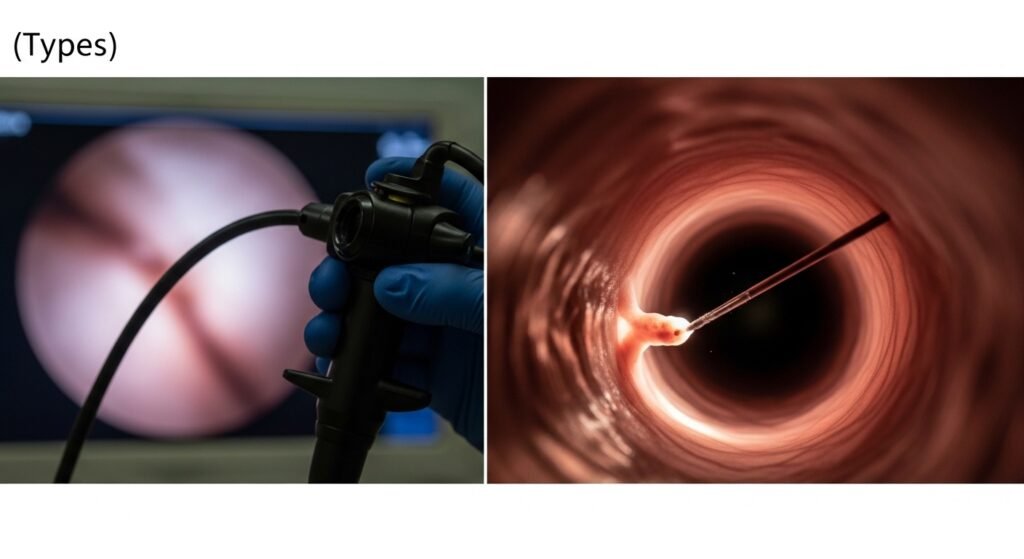
Endoscopy — visualization of internal body structures using a flexible camera scope — encompasses a broad range of procedures performed at gastroenterology, pulmonary, urology, and surgical clinics. Beyond upper endoscopy (EGD) and colonoscopy, endoscopic technology has expanded to procedures examining the airways, joints, sinuses, bladder, and reproductive organs. Understanding the range of endoscopic procedures available helps patients appreciate their medical options and prepare appropriately for recommended procedures. This guide provides an overview of the major endoscopic procedure types.
GI Endoscopy Procedures
Upper endoscopy (EGD) examines the upper GI tract. Colonoscopy examines the colon. ERCP (endoscopic retrograde cholangiopancreatography) uses endoscopy combined with fluoroscopy to access and treat bile duct and pancreatic duct disorders. Capsule endoscopy uses a swallowed wireless camera capsule to image the small intestine between the stomach and colon — inaccessible to standard endoscopes. Endoscopic ultrasound (EUS) provides ultrasound imaging of structures adjacent to the GI tract.
Respiratory Endoscopy
Bronchoscopy examines the airways (bronchi) using a flexible scope passed through the mouth or nose, performed at pulmonary clinics to evaluate respiratory symptoms, collect specimens for culture or biopsy, and treat airway obstructions or bleeding. Navigational bronchoscopy uses imaging guidance to reach peripheral lung lesions for biopsy.
Urological Endoscopy
Cystoscopy examines the bladder and urethra through a scope passed through the urethra, performed at urology clinics for hematuria evaluation, bladder tumor surveillance, and stone removal. Ureteroscopy examines the ureters and renal pelvis for stone removal and upper tract evaluation.
Musculoskeletal Endoscopy
Arthroscopy uses a small camera inserted through tiny joint incisions to examine and treat joint disorders — the knee, shoulder, hip, and wrist. Arthroscopic surgery enables joint repair (ACL reconstruction, rotator cuff repair, meniscus surgery) through small incisions with faster recovery than open surgery.
Conclusion
Endoscopic procedures have transformed medicine across specialties — providing diagnostic visualization and therapeutic intervention through minimally invasive approaches that decades ago required open surgery. Understanding which type of endoscopy is recommended for your specific condition helps you prepare appropriately and engage more meaningfully with your care team’s recommendation.
FAQs – Endoscopic Procedures
Q1. Are all endoscopic procedures performed under sedation?
A: Sedation protocols vary by procedure. Upper endoscopy and colonoscopy are typically performed under moderate or deep sedation. Cystoscopy is often performed under local anesthesia. Bronchoscopy uses moderate sedation or local anesthesia depending on extent. Arthroscopy requires regional or general anesthesia.
Q2. How quickly can I return to normal activity after endoscopy?
A: Most GI endoscopic procedures allow return to normal activity the following day. Arthroscopic surgery requires more structured recovery — typically 1–6 weeks depending on the procedure performed. Your care team provides specific return-to-activity guidance.
Q3. What is the difference between diagnostic and therapeutic endoscopy?
A: Diagnostic endoscopy visualizes structures and collects biopsies. Therapeutic endoscopy performs treatments through the scope — removing polyps, stopping bleeding, dilating strictures, removing stones. Modern endoscopy is frequently both diagnostic and therapeutic in a single session.
Q4. Can endoscopy detect all GI problems?
A: Endoscopy directly visualizes the GI mucosal surface and collects tissue samples. It does not assess the bowel wall layers as well as CT/MRI, does not image the small intestine comprehensively (except via capsule endoscopy), and cannot detect conditions not affecting the mucosal surface. Complementary imaging may be needed for complete GI evaluation.
Q5. Is endoscopy safe for elderly patients?
A: Yes, with appropriate preparation and monitoring. Elderly patients with significant cardiopulmonary comorbidities require careful sedation management — anesthesiology involvement is sometimes appropriate for higher-risk patients. The benefits of endoscopy in clinically indicated situations outweigh procedural risks for most elderly patients.