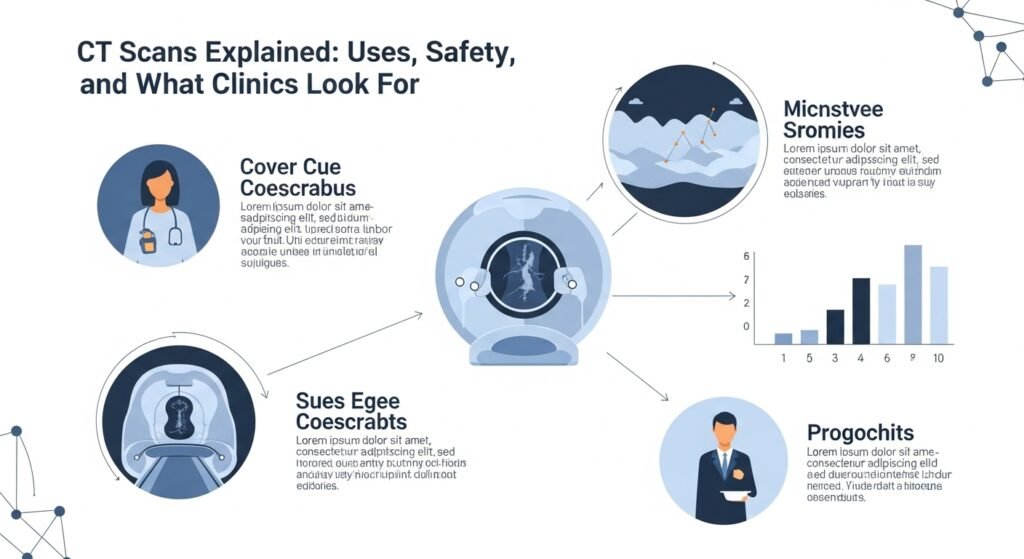
Computed tomography (CT) scans use X-ray technology combined with computer processing to create detailed cross-sectional images of the body — far more detailed than conventional X-rays and faster to perform than MRI. CT scans have revolutionized emergency and diagnostic medicine, allowing rapid diagnosis of conditions that once required exploratory surgery or prolonged evaluation. Medical clinics coordinate CT scanning for a wide range of diagnostic indications. This guide explains CT scanning — its uses, safety profile, and what clinicians are looking for when they order one.
How CT Scans Work
A CT scanner rotates an X-ray source around the patient, acquiring multiple images from different angles that a computer reconstructs into detailed cross-sectional (axial) slices — and increasingly, three-dimensional reconstructions. Modern multi-detector CT scanners complete whole-body scans in seconds. Different tissues (bone, fat, soft tissue, blood vessels) absorb X-rays differently, producing the tissue contrast that makes CT diagnostically useful.
Common Clinical Uses
- Emergency diagnosis of stroke, pulmonary embolism, aortic dissection, appendicitis, trauma injury
- Chest CT for lung cancer screening, pneumonia evaluation, mediastinal masses
- Abdominal CT for GI disorders, liver/kidney/pancreatic lesions, abdominal pain evaluation
- Head CT for bleeding, fracture, tumor screening
- CT angiography for blood vessel evaluation
- CT-guided biopsy for tissue sampling of deep lesions
- Kidney stone diagnosis and localization
Radiation Considerations
CT scans use significantly more ionizing radiation than conventional X-rays — typically 2–10 millisieverts per study versus 0.01–0.1 mSv for plain X-rays. The associated lifetime cancer risk from a single CT scan is very low in absolute terms (estimated 1 in 1,000 to 1 in 10,000 for a single study) but not zero. Clinics follow the ALARA principle (as low as reasonably achievable) — ordering CT only when clinical benefit justifies the exposure, particularly in children and younger patients who have longer radiation accumulation periods.
Conclusion
CT scanning is one of the most powerful diagnostic tools in modern medicine — enabling rapid, accurate diagnosis of conditions that would otherwise take much longer to identify. Clinics order CT scans when the diagnostic information they provide genuinely changes clinical management in a way that outweighs the radiation consideration. Trust your provider’s clinical judgment when a CT is ordered — the benefit in the specific clinical context almost always justifies the examination.
FAQs – CT Scans
Q1. What is CT contrast and when is it used?
A: Iodinated contrast dye injected intravenously enhances blood vessels and organ parenchyma, improving detection of tumors, abscesses, pulmonary emboli, and vascular lesions. Oral contrast highlights the GI tract. Kidney function is checked before IV contrast administration due to risk of contrast-induced nephropathy.
Q2. Is CT safer than MRI?
A: MRI does not use ionizing radiation, making it safer from a radiation standpoint for non-emergency imaging. CT provides faster results and superior imaging for many conditions (bone, acute bleeding, lung, bowel). Each modality has clinical situations where it is superior — the choice is based on what information is needed, not simply radiation avoidance.
Q3. Can CT scans detect all cancers?
A: CT detects many but not all cancers. Detection depends on lesion size (cancers below 5–10mm are often not detected), location, and tissue type. CT is not a universal cancer screening tool — specific low-dose CT protocols for lung cancer screening are the primary screening application.
Q4. Do I need to lie still during a CT scan?
A: Yes, but for only seconds to a few minutes during the actual scanning. The table moves through the scanner ring while you hold your breath for chest/abdominal images. CT is fast enough for uncooperative patients (trauma, children) to be managed with brief breath-hold instructions.
Q5. Are CT scans performed at the primary care clinic?
A: Most primary care clinics do not have CT scanners on-site — they order CT from affiliated radiology departments or imaging centers and receive the radiology report. Some larger integrated health systems have on-site CT capabilities.