Cognitive impairment — ranging from mild cognitive impairment (MCI) to dementia — affects an estimated 5.8 million Americans with Alzheimer’s disease and millions more with other forms of dementia. Early identification through clinical cognitive assessment allows earlier intervention, better care planning, and access to treatments and support that significantly improve quality of life for patients and caregivers. Medical clinics perform initial cognitive screening and coordinate further specialist evaluation when indicated. This guide explains how clinics assess cognitive function.
When to Screen for Cognitive Impairment
Cognitive screening is appropriate when: a patient or family member reports memory or thinking concerns, a clinician notices cognitive symptoms during a routine visit, or as part of standard care for older adults (Medicare’s Annual Wellness Visit includes cognitive screening). Common presenting concerns include getting lost in familiar places, difficulty managing finances or medications, repetitive questioning, word-finding difficulty, and personality or behavior changes.
Cognitive Screening Tools
Mini-Cog
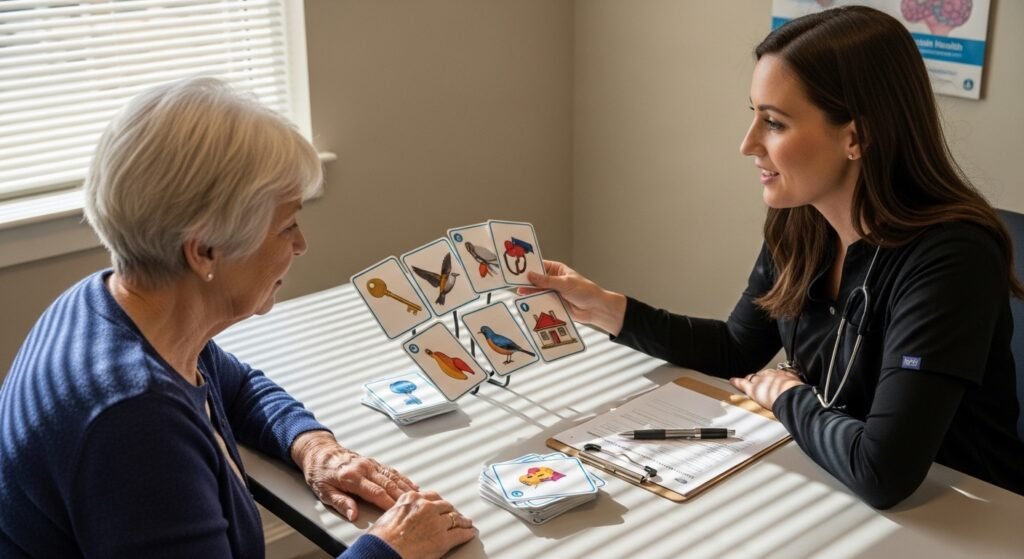
A 3-minute test used in busy primary care settings: the patient learns three words, draws a clock, and recalls the three words. Missed words plus an abnormal clock drawing are highly sensitive for dementia screening.
Montreal Cognitive Assessment (MoCA)
A more sensitive 10-minute test assessing multiple cognitive domains: visuospatial function (clock drawing, 3D cube copy), naming (unusual animals), memory, attention and working memory, language, and orientation. The MoCA detects mild cognitive impairment that the simpler MMSE can miss.
Mini-Mental State Examination (MMSE)
The most historically used screening tool, assessing orientation, registration, attention, recall, and language. Less sensitive than MoCA for mild impairment.
Beyond Screening: Clinical Evaluation
Abnormal screening results prompt comprehensive evaluation including detailed history (from patient and caregiver), complete neurological examination, laboratory evaluation (TSH, B12, folate, CBC, metabolic panel — all reversible causes of cognitive impairment), and brain imaging (MRI to detect structural causes). Neuropsychological testing and neurology referral provide definitive cognitive characterization when needed.
Conclusion
Cognitive screening at the clinic is the entry point to a diagnostic process that identifies reversible causes of cognitive impairment, accurately diagnoses dementia, and enables the care planning that supports patients and families through a challenging condition. Do not normalize memory changes as “just aging” without clinical evaluation — many causes are treatable, and even when they are not, early diagnosis opens access to support and planning that makes an enormous difference.
FAQs – Cognitive Screening
Q1. Is memory loss always dementia?
A: No. Memory difficulties have many causes — depression, anxiety, sleep disorders, medications, thyroid disease, vitamin deficiencies, and normal age-related changes. Comprehensive evaluation distinguishes these from dementia, which involves progressive cognitive decline across multiple domains impacting daily function.
Q2. What is mild cognitive impairment (MCI)?
A: MCI is cognitive decline greater than expected for age but not severe enough to interfere with daily function — essentially a clinically significant middle ground between normal aging and dementia. Approximately 10–15% of people with MCI develop dementia per year. Close monitoring and management of modifiable risk factors is the primary intervention.
Q3. Can dementia be prevented?
A: No definitive prevention exists, but risk reduction is meaningful. The Lancet Commission on Dementia Prevention identifies 12 potentially modifiable risk factors — including hypertension, hearing loss, physical inactivity, smoking, depression, social isolation, and diabetes — whose management could prevent or delay up to 40% of dementia cases.
Q4. Should I bring a family member to a cognitive evaluation?
A: Yes, if possible. Caregiver report of observed cognitive and behavioral changes provides essential information that the patient may not be able to self-report. The presence of an informed family member often significantly improves the quality of cognitive evaluation.
Q5. Are there medications that treat Alzheimer’s disease?
A: Currently approved medications provide modest symptomatic benefit but do not alter disease progression: cholinesterase inhibitors (donepezil, rivastigmine, galantamine) and memantine. Lecanemab (Leqembi) and donanemab, recently approved anti-amyloid antibodies, slow disease progression in early Alzheimer’s for carefully selected patients — representing the first disease-modifying treatments for the condition.