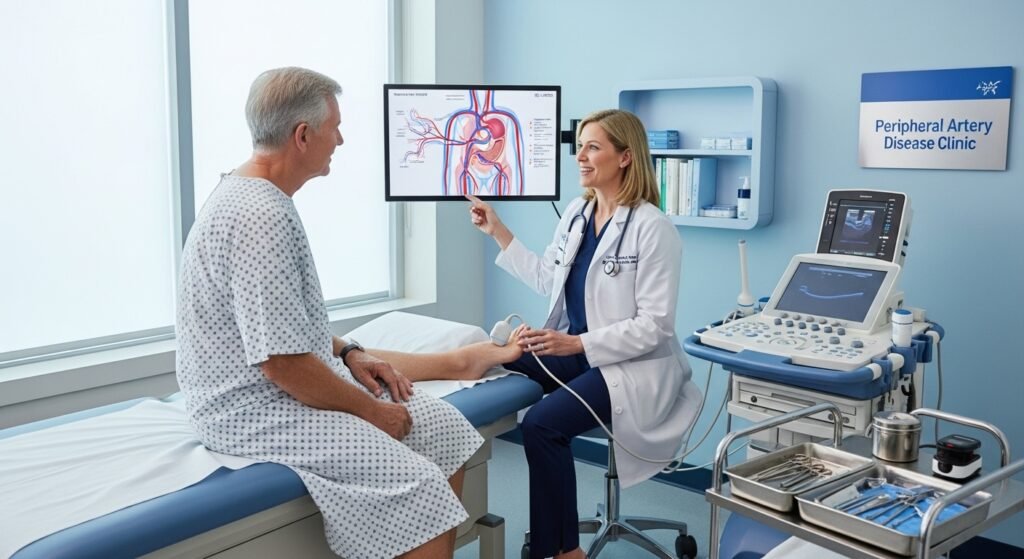
Peripheral artery disease (PAD) — narrowing of the arteries that supply blood to the legs (and less commonly, the arms) — affects approximately 8 million Americans and is a powerful marker of systemic cardiovascular disease. The same atherosclerotic process narrowing leg arteries is narrowing coronary and carotid arteries — meaning PAD patients have significantly elevated risk of heart attack and stroke. Medical clinics diagnose PAD, manage its cardiovascular risk implications, and coordinate care to prevent limb-threatening complications. This guide explains clinical PAD care.
Symptoms and Diagnosis
Classic PAD causes intermittent claudication — cramping leg pain during walking that resolves with rest, caused by inadequate blood supply during exertion. However, many PAD patients are asymptomatic. Severe PAD can cause rest pain, non-healing foot wounds, and critical limb ischemia threatening amputation. Diagnosis uses the ankle-brachial index (ABI) — comparing blood pressure at the ankle to the arm; an ABI below 0.9 confirms PAD.
Cardiovascular Risk Management
Because PAD is a coronary artery disease equivalent, aggressive cardiovascular risk factor management is the most important treatment: smoking cessation (smoking is the most powerful PAD risk factor), blood pressure control, statin therapy (which reduces both cardiovascular events and PAD progression), diabetes management, and antiplatelet therapy (aspirin or clopidogrel). These measures reduce the high risk of heart attack and stroke that accompany PAD.
Supervised Exercise Therapy
Supervised exercise therapy — structured walking programs that gradually extend the claudication-free walking distance — is the most evidence-based treatment for claudication symptoms. Exercise programs improve symptoms as effectively as stenting in many patients by promoting collateral blood vessel development.
Conclusion
PAD is a serious condition with implications far beyond leg pain — it signals systemic arterial disease requiring comprehensive cardiovascular risk management. If you have leg cramping with walking, cold or pale legs, poor wound healing on feet, or multiple cardiovascular risk factors, discuss PAD screening with your clinic. Identifying and managing PAD protects your legs and your life.
FAQs – Peripheral Artery Disease
Q1. Is PAD the same as DVT?
A: No. PAD is arterial disease (narrowed arteries, reduced blood flow to legs). DVT is venous disease (blood clots in veins, causing swelling and clot risk). Both affect the legs but through different mechanisms requiring different management.
Q2. What is critical limb ischemia?
A: The most severe form of PAD — inadequate blood supply causing rest pain, ulceration, or gangrene. Critical limb ischemia requires urgent vascular specialist evaluation for revascularization (stenting or bypass surgery) to prevent amputation.
Q3. Does PAD affect the arms?
A: Peripheral artery disease can affect upper extremity arteries, though this is less common. Subclavian artery stenosis can cause arm claudication and the “subclavian steal syndrome” where blood flow to the brain is compromised.
Q4. Can PAD be reversed?
A: The underlying atherosclerosis cannot be fully reversed, but risk factor management (particularly smoking cessation and statin therapy) can stabilize disease and reduce progression. Revascularization procedures open or bypass narrowed arteries to restore blood flow.
Q5. Why are foot care and wound prevention so important in PAD?
A: Poor circulation impairs wound healing. A small cut or sore on the foot of a PAD patient can progress to a non-healing ulcer and ultimately require amputation. Daily foot inspection, meticulous hygiene, properly fitted footwear, and immediate evaluation of any wound are essential.